
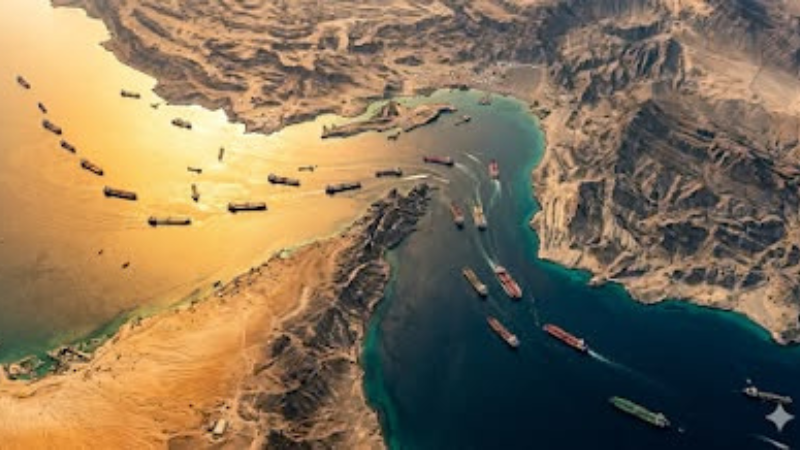
The crisis in the Strait of Hormuz has exposed a hard truth about global trade: geography creates opportunity, but digital readiness decides who captures it. For Pakistan, this is not only about diverted vessels or freight risk. It is about whether Karachi and Port Qasim can use PortVerse to convert disruption into a sustained logistics advantage.
Pakistan’s Strategic Position in a Shifting Maritime Landscape
As the Strait faces severe disruption, global trade flows are searching for stable maritime alternatives. Pakistan’s southern coast is increasingly viewed as a viable transshipment hub, positioned close enough to the Persian Gulf to remain relevant, yet far enough to sit outside the immediate conflict pressure and high-risk insurance zones affecting traditional hubs.
This shift places Pakistan inside a new trade architecture where port efficiency and cargo visibility matter as much as geography.
A Historic Surge in Transshipment Activity
The scale of this demand shock is historic. Karachi handled approximately 8,300 TEUs in transshipment cargo during the full year of 2025. In just the first 24 days of March 2026, that figure reached 8,860 TEUs, exceeding the entire previous year’s volume. Compared with the same period last year, the increase is reported at more than 1,400%.
This proves that a winning port is no longer just the nearest one, but the port that moves information as fast as cargo.
PortVerse: The Digital Backbone of Modern Port Operations
PortVerse, Pakistan’s Port Community System (PCS), provides the essential digital layer needed to manage this pressure. The transition is scaling rapidly across the country’s primary gateways. Following the successful switchover at Qasim International Container Terminal (QICT) on April 21, the Karachi Gateway Terminal (KGTL) is scheduled for integration on May 6, with SAPT and KICT expected to follow within two weeks.
This unifies all major containerised marine terminals under a single digital umbrella for Electronic Delivery Orders (eDO).
With over 17,000 DOs already initiated, PortVerse specifically targets documentation related bottlenecks. While overall dwell time is influenced by various operational factors, removing the friction of manual coordination is an important contributor to improving terminal efficiency and facilitating the higher velocity of trade Pakistan is currently experiencing.
Moving Beyond Transit: Capturing Value Across the Supply Chain
To capitalise on this momentum, the Ministry of Maritime Affairs and the Federal Board of Revenue (FBR)/Customs have introduced strategic measures that shift focus towards value-chain capture. Newly legalised procedures for the transshipment of bulk cargo, specialised Ro-Ro operations for the automotive sector, and LCL cargo consolidation are designed to integrate Pakistan more closely into global supply chains.
These initiatives also provide the essential flexibility required to facilitate transit for landlocked Central Asian countries.
Building a Resilient Trade Future
Ultimately, the Strait of Hormuz crisis is a reminder that while Pakistan cannot control geopolitical disruption, it can control the efficiency of its borders. By acting decisively to expand the PSW and PortVerse ecosystem, Pakistan is building a trade environment that is resilient to today’s challenges and is ready to lead the regional transshipment map for decades to come.